
Not every couple books a banquet hall.
More of the receptions we style now happen in restaurants, bars and lounges. Places the couple genuinely loves, with good food and a room full of memories, that were never designed to host a wedding. That was the case here. A working bar in Windsor, slate floors, dark stone walls, sport on the screens above the counter, and a couple who wanted their reception to feel soft and romantic anyway.
Here is how the K-Decor Studio Inc. team built that.
The couple was clear about two things. They wanted champagne and ivory rather than white, and they did not want the setup to look like it was fighting the venue.
That second point mattered more than it sounds. When you install a soft, pale, romantic setup into a dark room with hard surfaces, there is a version of it that looks wrong. Too pale, too delicate, sitting there like it wandered in from a different building. The setup has to feel like it belongs, which means working with the room’s warmth rather than pretending the room is not there.
Faiqa walked the space before anything was confirmed and made two calls immediately. Champagne satin rather than white, because a warm-toned fabric sits comfortably against dark wood and stone in a way that pure white does not. And every light source in the setup would need to come from us, because the venue’s own lighting was low, warm and entirely wrong for photographs.
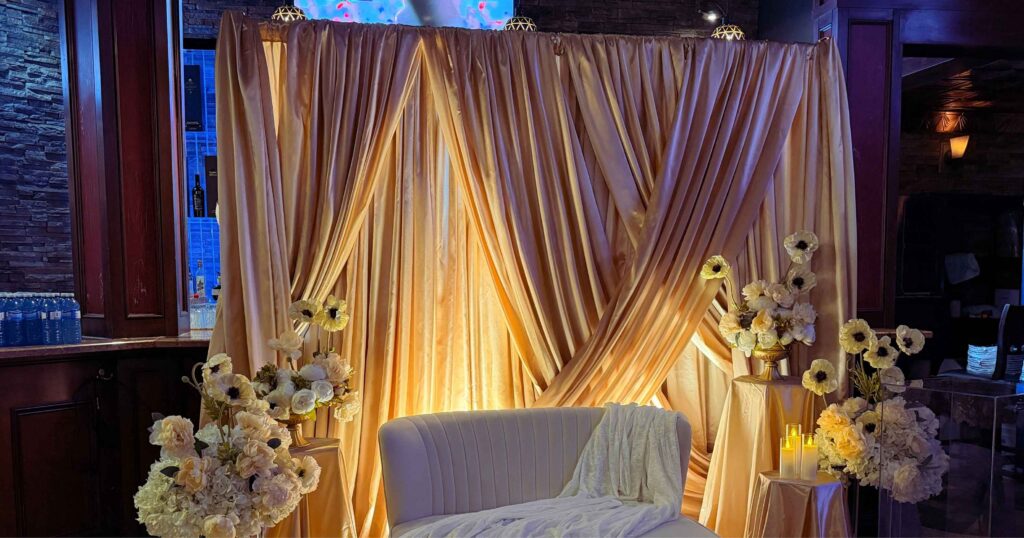
The backdrop covers the full width of the wall behind the seating, hung in champagne satin panels.
Satin was a deliberate choice over velvet here. The two fabrics behave completely differently under light. Velvet absorbs and diffuses, which is why it works so well in bright rooms where you want to soften glare. Satin reflects directionally, which means it shows you exactly where your light is coming from. In a dark venue where we were supplying all the light ourselves, that reflectivity is what makes the backdrop glow rather than just sit there.
Across the centre of the backdrop we ran two wide panels in a criss-cross, crossing at roughly two thirds height and falling outward in opposite directions.
The criss-cross does something specific on a wide wall. A flat run of vertical pleating across that much width reads as a curtain, and the eye slides along it without stopping. Two diagonal panels crossing over the centre break that horizontal pull and create a natural focal point directly above where the couple sits. It adds structure without adding a second colour, which matters when the whole palette is one tone.
Behind the panels, warm uplighting at floor level pushes light up through the fabric from behind.
Every floral arrangement in this setup is cream, ivory and white. Peonies, ranunculus, hydrangeas, garden roses. Soft, full, and on their own, slightly flat.
The white anemones are what fix that.
Anemones have a dark centre, almost black, and in this setup they are the only dark points anywhere. Not in the draping, not in the seating, not in the candles. Just those centres, scattered through the arrangements at varying heights on tall stems.
That contrast is doing more work than any other single element here. An all-cream floral arrangement in a dimly lit room loses definition quickly, because there is nothing for the eye to catch. The anemone centres act as punctuation. They give every arrangement a set of fixed points, which makes the surrounding cream blooms read as full and layered rather than as one pale mass.
The arrangements sit at three heights. Tall acrylic pedestal stands at the outer edges, gold urn vases on satin-draped cocktail tables at mid height, and lower clusters near the base.
The seating is a single cream channel-tufted loveseat with gold hairpin legs, with an ivory crushed velvet throw draped across one side and pooling onto the floor.
One loveseat rather than two chairs was the right call for this room. The setup area was narrow, wedged between the bar and the seating floor, and two separate chairs with a gap between them would have made an already tight space feel more divided than it was.
Underneath everything sits a patterned ivory and grey area rug.
In a banquet hall a rug is a decorative choice. In a venue like this one it is structural. The floor is slate tile, dark and hard, running continuously through the whole room. Without a rug the setup has no edge. It just stops, and the venue floor carries on underneath it. The rug is what draws a boundary around the setup and tells anyone looking at it that this specific area is the reception space and the rest of the room is not.
There are two lighting layers in this setup and both were brought in.
Warm uplighting sits behind the draping at floor level, angled upward, which is what produces the amber glow through the satin. Placed in front of the fabric it would have flattened the whole backdrop and lit the seating harshly. Behind it, the fabric diffuses the light and the backdrop becomes the light source rather than the thing being lit.
The second layer is candlelight. LED pillar candles in glass cylinders, grouped on the side tables and, importantly, at floor level around the base of the setup.
In a dark venue, put candles at floor level, not only on tables. In a brightly lit hall floor candles barely register. In a dark room the base of a setup is the first part to disappear into the surroundings, and a few candles at ground level are what keep the whole arrangement anchored to the floor instead of appearing to float in shadow.
STYLING TIP
If your reception is booked at a restaurant, bar, lounge or any venue that was not built for weddings, that is not a problem. It is usually a better story.
Details are on our wedding decor and styling services page (kdecor.ca/wedding-event/), or browse the backdrop and event rental collection (kdecor.ca/event-rentals/) for draping, seating and floral options.
K-Decor Studio Inc. is booking 2026 and 2027 receptions across Windsor and Ontario.
Yes, and we do it regularly. Restaurants, bars and lounges usually need more from a decorator than a banquet hall does, particularly lighting and floor definition, because they were not designed with events in mind. We walk the venue before quoting so nothing is a surprise on setup day.
Yes. Uplighting and candlelight are included in setups where the venue cannot supply appropriate lighting itself, which is most non-traditional venues. In the setup shown here, every light source was ours.
Yes. The champagne and ivory palette here was chosen to suit a dark venue with wood and stone surfaces. Every setup is colour-matched to your palette and to the room it is going into, which are two separate considerations.
Six to twelve months for weddings between May and October. Non-traditional venues need a site visit before the date is confirmed, so booking earlier gives more room to plan around the venue's own constraints.

Zara Collins brings 6+ years of content writing expertise to every project, specializing in lifestyle and creative content that resonates with modern audiences. Her work focuses on creating authentic, reader-friendly content that performs well in search engines while building genuine connections with readers.