
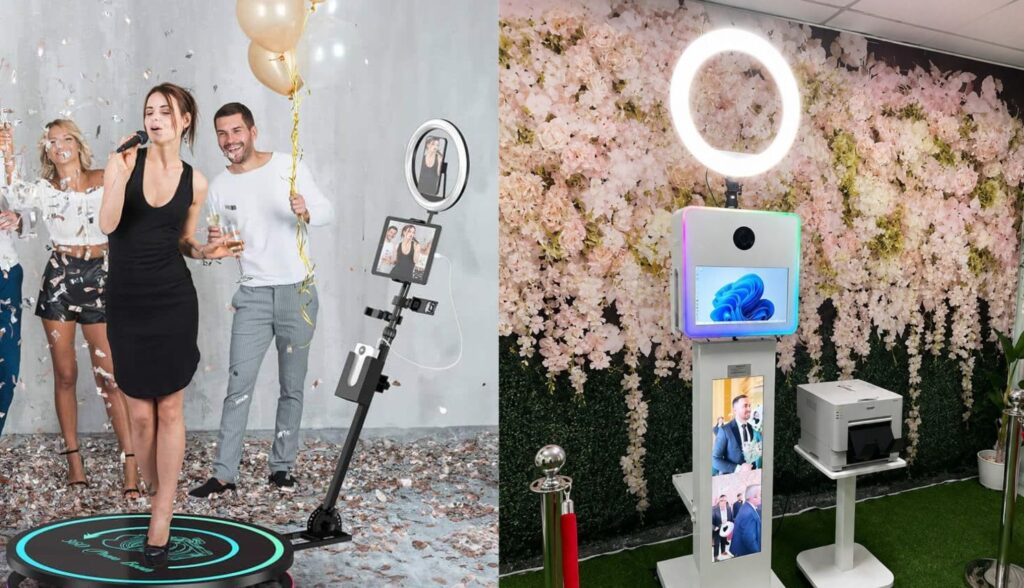
One of these moves your whole guest list through in an hour. The other draws a crowd and moves almost nobody.
That sentence is the entire decision, and almost every 360 photo booth vs regular photo booth comparison I read online skips it in favour of listing features. Both booths take good photographs. What separates them is how many of your guests actually get in front of one before the night ends. I have set up both at K-Decor Studio Inc. and watched the difference play out in real rooms.
So here is what each one really delivers, and which rooms I would put them in.
Guests stand on a raised platform while a camera arm swings around them, filming in slow motion.
The output is a short video rather than a photograph. Guests get it on their phone within a minute or two and most of them post it before the night is over, which is the appeal. It looks expensive, it photographs well from outside the booth as well as inside, and nobody has to explain what it is.
It also runs one group at a time, usually one to four people, and each turn takes a full cycle. That number matters more than anything else on this page, and I will come back to it.
If you want the full range of what we set up, our photo booth rental in Windsor covers it.
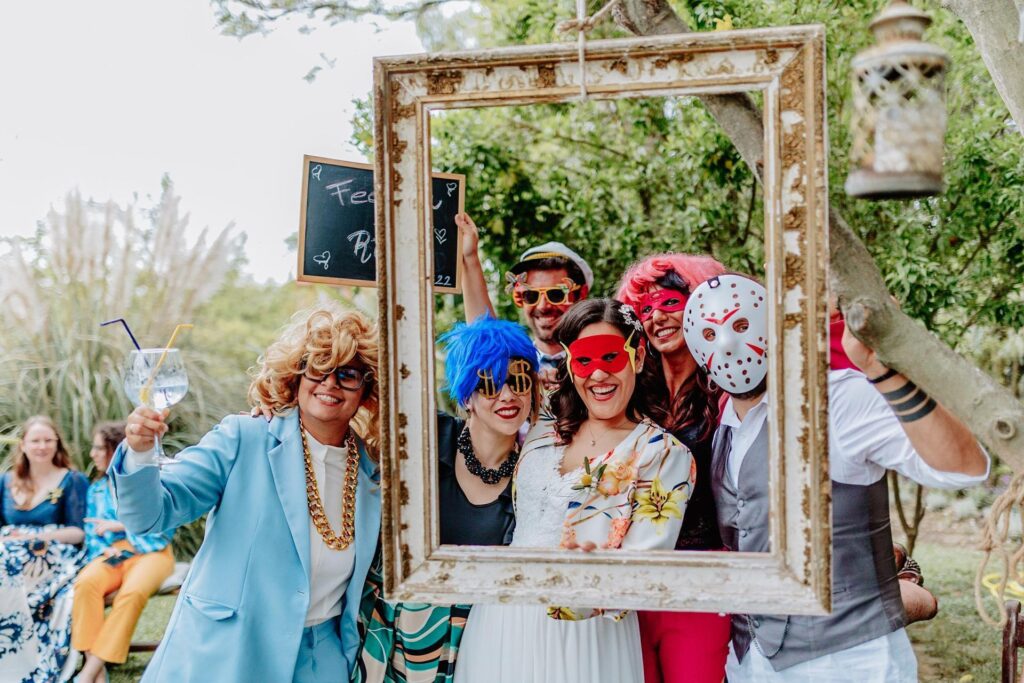
A classic open air booth takes six or eight people at once and hands them a printed strip before they have walked away.
That is a bigger deal than it sounds. Groups pile in together, which is how the funniest photographs happen, and the print goes straight into a pocket or onto a fridge. Weeks later somebody still has it. A video sits in a camera roll with four hundred other things.
The setup is also far more forgiving. Lower ceiling, smaller footprint, less fuss about what hangs overhead. It works in a restaurant private room, a community hall, a backyard marquee, and almost any space a 360 booth would be refused from.
It is less of a spectacle. Nobody stops to watch a classic booth running. They just use it, which is rather the point. I have had couples tell me afterwards that the guest book of printed strips was the thing they went back to, and nobody has ever said that to me about a video.
This is where the 360 photo booth vs regular photo booth decision actually gets made.
Run the numbers for your own guest list. A 360 booth handles one group per cycle, and between the posing, the filming and the clip landing on someone’s phone, each turn runs longer than people expect. Over three hours you reach a decent number of groups, not a decent number of guests.
A classic booth takes six at a time and prints while the next group is already stepping in. Over the same three hours it processes a different order of magnitude of people.
At 60 guests, either booth reaches most of the room. At 150, the 360 booth becomes an attraction that a portion of your guests experience and the rest photograph from a distance. Neither outcome is wrong. You just need to decide which one you are buying.
The other thing a queue does is pull people out of the room. If your 360 booth sits where the line blocks the bar or the dance floor path, you lose both for the evening.
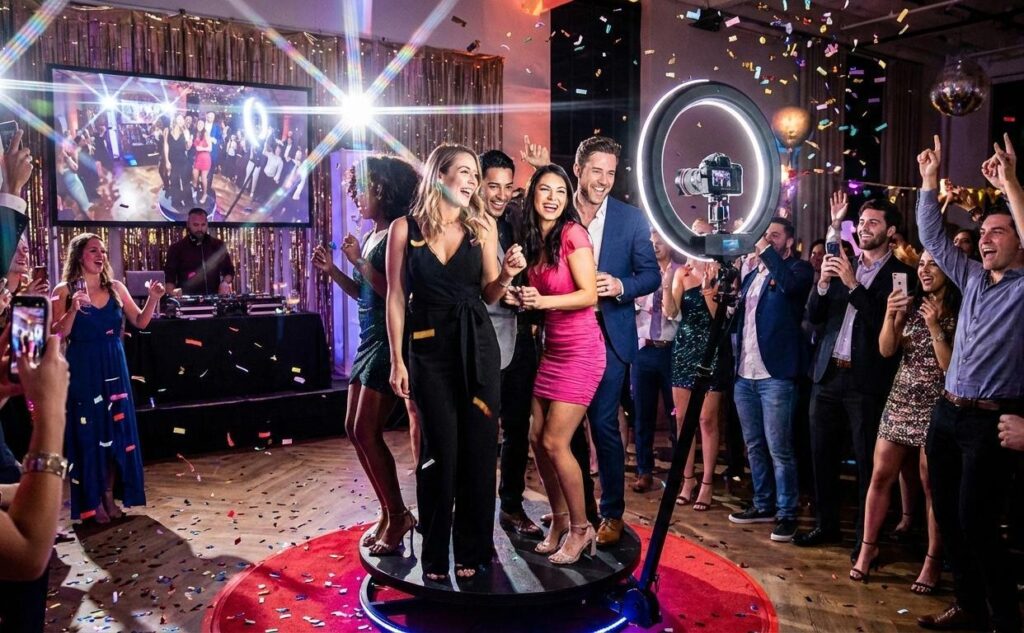
A 360 booth gets ruled out by the room more often than by budget.
It needs roughly ten by ten feet of clear floor and nine to ten feet of clear ceiling, because the arm swings a full circle at head height. Chandeliers, ceiling drapes and low fixtures all cut into that, and plenty of banquet rooms around Windsor quote a generous ceiling then hang two feet of lighting into it. The platform also has to sit level and solid, which rules out soft ground and thick padded carpet.
A classic booth asks for far less. Eight feet square, a standard ceiling, a wall to work against.
Before you fall for either, measure. Our guide to what a photo booth needs from your venue covers the footprints, clearances and power in detail, and it is worth sending to your venue coordinator before you book anything.
One hands them a file. The other hands them an object.
Prints get kept. I have been to weddings where the couple put a second copy of every strip into a guest book with a message beside it, and that book ends up being the thing they actually look at years later. A 360 clip cannot do that.
What a 360 clip does do is travel. It gets posted, shared and seen by people who were not at your event, which matters more at a corporate party or a brand event than at a family wedding.
Decide which outcome you want before you compare prices. If you are still working out the backdrop and placement side, our wedding photo booth ideas post covers that end of it.
Here is roughly how I would call it.
Event | What I would book | Why |
|---|---|---|
Wedding, under 100 guests | Either | Both reach the room comfortably at that size |
Wedding, 150 and up | Classic | Throughput, and your guests want the print |
Corporate party | 360 | The clip travels, which is half the reason the company is paying |
Brand launch or gala | 360 | Spectacle and shareable content both matter more than keepsakes |
Milestone birthday | Classic | Mixed ages, and older guests take the print |
Shower or engagement party | Classic | Smaller room, lower ceiling, people in groups |
Kids’ party | Classic | Nobody is standing still on a platform |
If you are planning the whole room rather than just the booth, we fold this decision into the layout as part of our wedding decor services in Windsor, because where the booth sits changes where everything else goes
You can, and at above roughly 200 guests it genuinely works.
Put them in different corners. The classic booth handles volume and gives everyone a print. The 360 booth becomes the feature people queue for because they want to, not because it is the only option. Two queues in two places also stops one bottleneck forming.
Below 200 guests I would not, and I will say so when couples ask. Two booths in a smaller room split the attention, and you end up paying twice for an experience that one booth would have delivered properly. Spend the difference on the backdrop instead and the one booth you do have will photograph better all night.
Five questions settle it faster than any comparison chart.
How many guests are coming, and do you want most of them to use it? What is the ceiling height in the room, measured to the lowest fixture? Where will the queue stand without blocking the bar or the dance floor? Do you want your guests leaving with something physical or something shareable? And is there an attendant included, because an unattended booth of either kind stops working the moment something jams.
Ask your supplier those five and the answer usually picks itself. If a supplier cannot answer the ceiling question or the attendant question, that tells you something on its own.
A 360 booth films a slow motion video from a rotating arm while guests stand on a platform, one small group at a time. A regular booth photographs six to eight people at once and prints immediately. The 360 produces shareable video, the classic produces keepsakes and far higher throughput.
At under 100 guests it works well. At 150 and above it reaches a smaller share of your guest list, so a classic booth usually serves a wedding better. The 360 earns its place at corporate and brand events where the clip travelling matters.
Around ten by ten feet of clear floor and nine to ten feet of ceiling, measured to the lowest fixture rather than the ceiling itself. Chandeliers and ceiling drapes rule out more rooms than floor space does.
Yes, and above roughly 200 guests it works well with the two placed in separate corners. Below that, one booth chosen properly beats two competing for the same guests.

Zara Collins brings 6+ years of content writing expertise to every project, specializing in lifestyle and creative content that resonates with modern audiences. Her work focuses on creating authentic, reader-friendly content that performs well in search engines while building genuine connections with readers.